

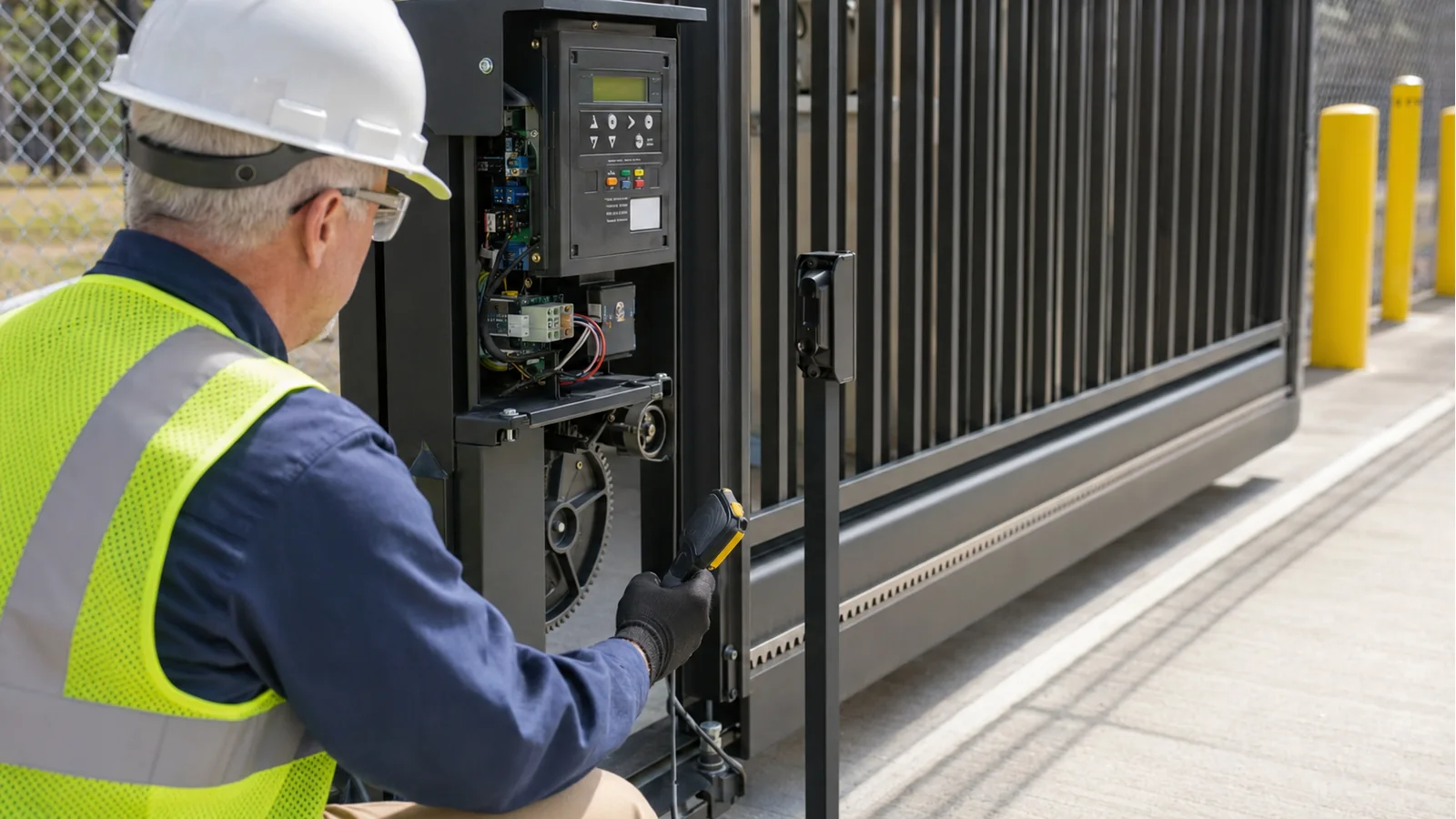
UL 325 is a safety standard covering door, gate and related operators and systems. For automatic vehicular gates, it addresses the operator, its intended type of installation and the methods used to reduce entrapment hazards.
The practical point for a property owner is simple: buying a listed gate operator is important, but it does not make the entire entrance safe by itself. The operator must be appropriate for the application, installed according to its current instructions and combined with the external monitored protection required for the gate’s actual entrapment zones.
What UL 325 covers
UL evaluates gate operators as products. A listed operator is marked for intended use and has been investigated against applicable safety requirements. Those requirements address topics such as controls, construction, electrical protection and entrapment-protection functions.
The standard has evolved over time. Current installation decisions should always be based on the edition adopted by the applicable authority, the operator’s current listing and the manufacturer’s instructions—not an old rule of thumb or an installation copied from another property.
The four usage classifications
Gate operators are identified for one or more general usage classes:
- Class I — Residential: typically a home of one to four single-family dwellings or an associated garage or parking area.
- Class II — Commercial/general access: typically multifamily housing, hotels, garages, retail locations and other properties serving the general public.
- Class III — Industrial/limited public access: typically factories, loading areas and industrial locations not intended to serve the general public.
- Class IV — Guarded restricted access: typically airport-security areas and other guarded industrial locations where unauthorized access is prevented by security personnel.
The classification matters because the equipment and safety strategy must reflect who uses the entrance and how access is controlled. A residential operator should not be assumed suitable for a busy apartment or public commercial entrance.
What is entrapment protection?
Entrapment protection is intended to reduce the risk of a person being trapped or crushed by a moving gate. Protection may include inherent force detection and external devices such as monitored photoelectric sensors and sensing edges.
The required arrangement depends on the operator, gate type, direction of travel and locations where entrapment can occur. A sliding gate can create different hazards from a swing gate, so the same sensor layout should not be copied from one configuration to another.
Modern monitored devices communicate their condition to the gate operator. If a required device is missing, disconnected, misaligned or fails its test, the controller may prevent normal movement or allow only restricted operation. That response is a warning to repair the system—not an invitation to bypass the input.
UL 325 and ASTM F2200 work together
UL 325 primarily addresses the gate operator and system safety functions. ASTM F2200 addresses the construction of automated vehicular gates, including physical features intended to reduce hazards.
In practical terms, a compliant operator cannot correct an unsafe gate structure. The gate may also need:
- Protection around exposed rollers
- Screening over hazardous openings
- Positive stops
- Fall-over or derailment protection
- Suitable spacing from fixed objects
- Control placement that prevents a person from reaching through the gate
- Warning signs on both sides
A professional design considers the operator standard and gate-construction requirements together.
Common misunderstandings
“The operator says UL Listed, so the installation is compliant.”
Not necessarily. The listing applies to the product and its approved use. Site conditions, gate construction, sensor selection, placement, wiring and programming determine whether the finished system follows the required installation.
“A vehicle loop is all the safety protection the gate needs.”
Vehicle detectors are useful for traffic presence, free exit and gate logic. Their function is not automatically the same as a monitored entrapment-protection device. The safety design must follow the operator’s instructions and address each entrapment zone.
“If a photo eye causes trouble, it can be jumped temporarily.”
Bypassing a monitored sensor can remove a critical layer of protection and may cause the operator to behave differently from its listed configuration. The cause—alignment, wiring, water intrusion, damage or an incorrect device—should be repaired.
“An older gate is grandfathered forever.”
Codes, enforcement and legal questions depend on jurisdiction and circumstances, but age does not make a hazardous condition acceptable. When an operator is replaced or a system is substantially modified, the complete entrance should be evaluated against current requirements and manufacturer instructions.
What property owners should ask
When installing or upgrading an automatic gate, ask:
- Is the proposed operator listed for this application class?
- What entrapment zones exist in both directions of travel?
- Which monitored devices protect each zone?
- Does the gate construction follow applicable automated-gate requirements?
- Is there a separate pedestrian entrance?
- Who is responsible for electrical work, programming and final testing?
- What inspection and maintenance records will be provided?
- How will users be trained to report faults and unsafe behavior?
The proposal should identify safety equipment clearly instead of burying it among optional accessories.
What happens when an older operator is replaced?
Replacing the motor or control cabinet is not always a like-for-like repair. A new operator may require compatible monitored sensors, updated wiring and corrections to gate construction or site hazards. Existing loops, photo eyes or edges may not be approved for the new operator.
This is why an operator replacement should begin with a survey of the complete gate system. The goal is not merely to make the gate move again; it is to return the entrance to dependable, properly protected operation.
Why qualified installation matters
Gate safety crosses several trades: structural metalwork, mechanical movement, electrical work, controls, vehicle detection and access management. When responsibilities are fragmented, important interfaces can be missed.
Access Control Jacksonville and Edwards Ornamental Iron evaluate the entrance as one system. Edwards has served the region since 1947, is licensed and insured, holds a Florida electrical license and has factory-trained technicians experienced with residential, community and commercial gate systems.
Call (904) 354-4282 to request an automatic-gate safety and system review.
Suggested internal links: Automatic Gate Safety; Photo Eyes vs. Safety Edges; Choosing the Right Gate Operator; Retrofitting Safety Devices on an Older Gate.
# Editorial source notes
- UL, “Gate Operators—An Open and Shut Case for Safety”: https://code-authorities.ul.com/wp-content/uploads/2014/04/UL_Gate-Operator-1.pdf
- Door & Access Systems Manufacturers Association, gate opener safety resources: https://www.dasma.com/gate-openers/
- DASMA Technical Data Sheet 352, automated vehicular gate safety: https://www.dasma.com/wp-content/uploads/2024/01/TDS352.pdf
Final publication should follow the operator and sensor manufacturers’ current instructions, the requirements adopted by the applicable authority, and Edwards’ technical review.