

acs-logo-white

Access Control System

How to Choose the Right Gate Operator for Your Property

Operator selection depends on the gate, traffic, wind, power, safety and access-control requirements

The right gate operator is not simply the model with enough advertised horsepower to move the gate. It must be listed for the intended application and matched to the gate’s configuration, size, weight, balance, wind exposure, traffic volume, power source, safety requirements and access-control system.

A properly selected operator should move a mechanically sound gate reliably without being used to compensate for bad hinges, undersized posts, damaged rollers or poor geometry.

Begin with the gate—not the motor

Before selecting an operator, confirm that the gate is structurally sound and moves freely by hand when properly disconnected according to the manufacturer’s procedure. A gate that binds or rolls poorly will overload almost any operator.

The installer should document:

  • Swing, slide, cantilever, vertical-pivot or barrier configuration
  • Gate leaf length, height, weight and construction
  • Number and location of hinges, rollers and guides
  • Opening direction and available clearance
  • Slope, drainage and pavement conditions
  • Solid surface area exposed to wind
  • Entrapment and pinch-point locations

The operator should be selected after these conditions are known.

Match the operator to the application class

Gate operators are marked for intended usage classifications. In general, a single-family residential installation is different from multifamily or public commercial property, an industrial facility, or a guarded restricted-access site.

Using a residential operator at a busy community entrance can lead to overheating, excessive wear and premature failure. Using heavy commercial equipment does not eliminate the need for correct safety design; the operator and installation still must be appropriate for the application.

Estimate real traffic and duty cycle

Ask how many complete cycles the gate will make on a typical day and during the busiest hour. A household with a few vehicles has very different requirements from an apartment community during the morning rush or a warehouse with continuous truck traffic.

Include visitors, deliveries, contractors, waste collection and special events. If the entrance cannot tolerate downtime, consider serviceability, available parts, backup power and whether the site needs redundancy or a separate exit arrangement.

Select the correct operator type

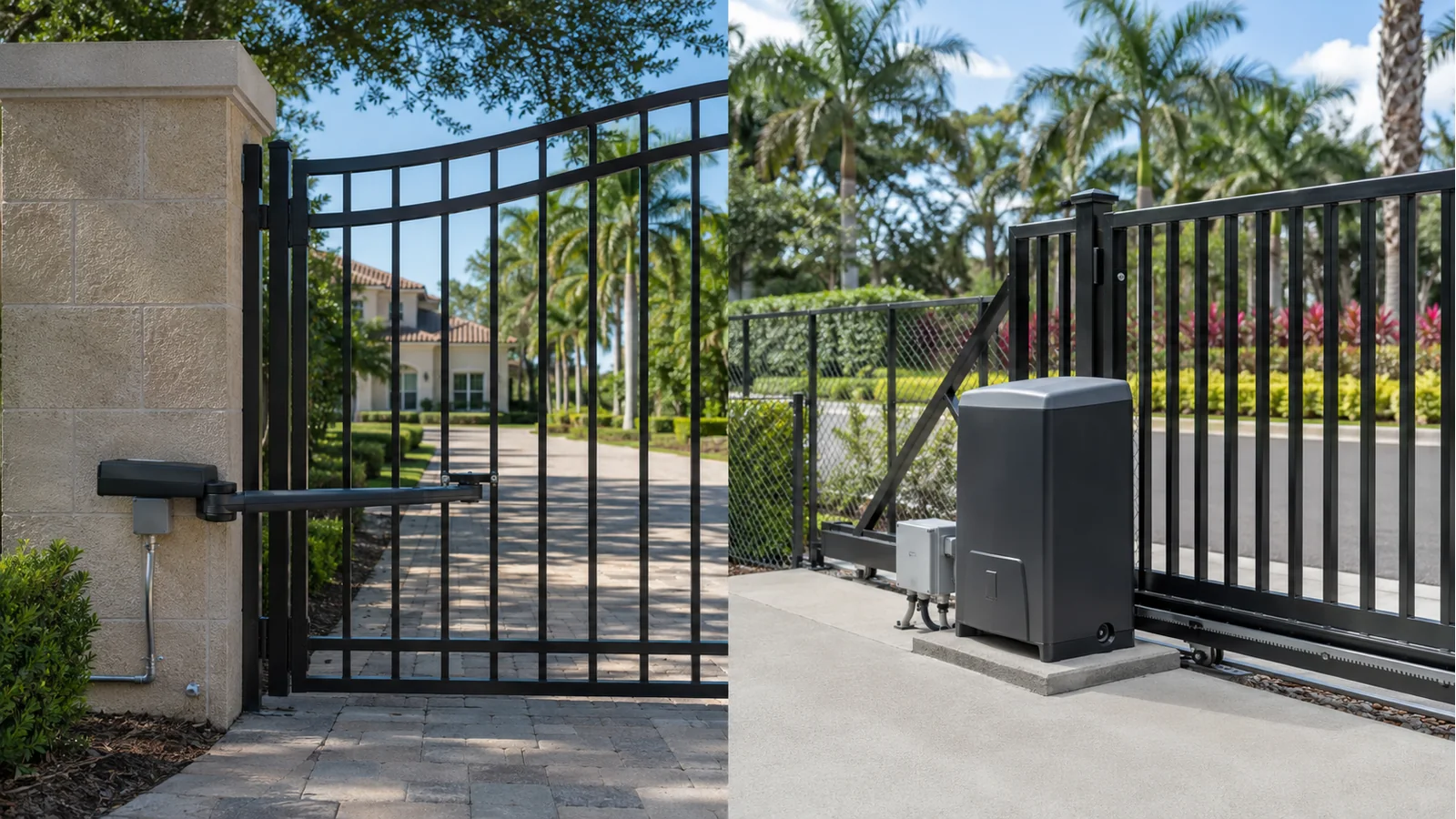
Swing-gate operators

Common choices include linear arms, articulated arms, pad-mounted operators with mechanical linkages and underground operators. The right type depends on gate geometry, desired appearance, wind loading, available space and service access.

Slide-gate operators

Slide operators are commonly used where a gate must move parallel to the fence. The operator must match the gate weight, length, speed and duty cycle. The design also needs adequate runback space, guides, screening and protection of entrapment zones.

Barrier-arm operators

Barrier arms control vehicles quickly but do not create the same perimeter barrier as a full gate. They are often used in parking and traffic-control applications, sometimes with a separate security gate.

Account for wind

Wind loading is frequently underestimated in Florida. An open-picket gate allows air to pass through; a solid privacy gate can behave like a sail. The operator, posts, hinges and foundations must be designed for the gate’s actual surface area and site exposure.

Adding privacy panels to an existing gate can change the load dramatically and may make the current operator unsuitable.

Decide how the gate will be powered

Hardwired AC power is often preferred when available, particularly for high-use systems. Many modern operators use DC motors with battery backup. Solar may be practical at remote, lower-cycle locations with good sun exposure, but it must be sized for the site, battery capacity, accessories and periods of poor weather.

In Northeast Florida, surge protection, grounding, water management and lightning exposure deserve special attention.

Design the safety system at the same time

Operator selection and entrapment protection are inseparable. Monitored photo eyes, sensing edges, guards and screening must address the hazards created by the specific gate. The number and placement of devices depend on whether the gate swings or slides and where a person could be trapped.

Vehicular gates are intended for vehicles. A separate pedestrian route should be provided rather than expecting people to walk through the automatic gate opening.

Confirm access-control compatibility

The operator may need to communicate with:

  • Remote transmitters and receivers
  • Keypads or card readers
  • RFID, barcode or mobile credentials
  • Telephone-entry and video-intercom systems
  • Vehicle loops and free-exit sensors
  • Fire-access devices
  • Cameras, alarms or building access control
  • Cloud management and event reporting

The design should define how the gate behaves when power, internet or cellular service is interrupted and how authorized personnel obtain emergency access.

Consider ownership—not just purchase price

An operator that is difficult to service or poorly supported can cost more over its life. Evaluate:

  • Manufacturer support and parts availability
  • Warranty terms and who provides labor
  • Expected battery and wear-item replacement
  • Diagnostic capability and service access
  • Preventive-maintenance requirements
  • Local technician familiarity

Why professional sizing matters

Gate operators are part of a moving electromechanical system with significant force. Correct selection requires structural, electrical, access-control and safety judgment. Edwards combines those disciplines: custom gate fabrication, a Florida electrical license, factory-trained technicians and experience with residential, community and commercial systems.

Call (904) 354-4282 to request a gate-operator assessment. Edwards serves Northeast Florida and Southeast Georgia, from Sea Island to Daytona Beach.

Suggested internal links: Swing Gate vs. Sliding Gate; Residential vs. Commercial Gate Operators; Gate Operator Repair or Replacement; UL 325 Automatic Gate Safety.